
Body-Mind Centring & Baby Moves
Mindful movements
You may have come across the term at your midwife’s practice or heard other mums talking about it at yoga classes: Body-Mind Centring (BMC) or, more specifically, Baby Moves. This approach, which focuses on body awareness, is becoming increasingly popular.
As parents, we often eagerly await our baby’s next developmental milestone (When will they finally start crawling?). But Body-Mind Centring is about something quite different. It focuses on deep inner awareness. We explain what makes this wonderful approach so special.
💡 The essentials of BMC / Baby Moves
- It's about the journey, not the destination: The focus is not on whether a baby can sit up, but on how they achieve it, for example, by shifting their weight.
- Mindful touch: Parents learn to touch their babies mindfully to support their body awareness and sense of self.
- Yielding: Before a baby can push themselves up, they must first learn to transfer their weight safely onto the floor.
- Support rather than pull: Instead of pulling babies into certain positions, parents encourage them to push themselves up by applying gentle pressure, for example, to their feet.
What is Body-Mind Centring (BMC)?
Body-Mind Centring was developed by American Bonnie Bainbridge Cohen. Originally designed to improve body awareness in adults, particularly dancers, its principles have since been adapted for babies through the 'Baby Moves' (or 'Infant Developmental Movement') programme.
The approach is based on the idea that our earliest movement patterns influence us throughout our lives, both physically and emotionally. Babies who learn to rest their weight securely on the floor and support themselves effectively may develop a stronger sense of stability later in life.
Yielding and pushing
One of the most fascinating concepts in BMC is the relationship between 'yielding' and 'pushing'.
- Yielding (relaxing and letting go): A newborn must first learn to trust gravity and allow their weight to rest fully on the floor or in their mother's arms. When a baby feels secure, their body relaxes and becomes soft and heavy.
- Pushing: Once a baby has learnt to rest their weight on the floor, they can begin using it to push themselves up, whether to lift their head or, later, to start crawling.
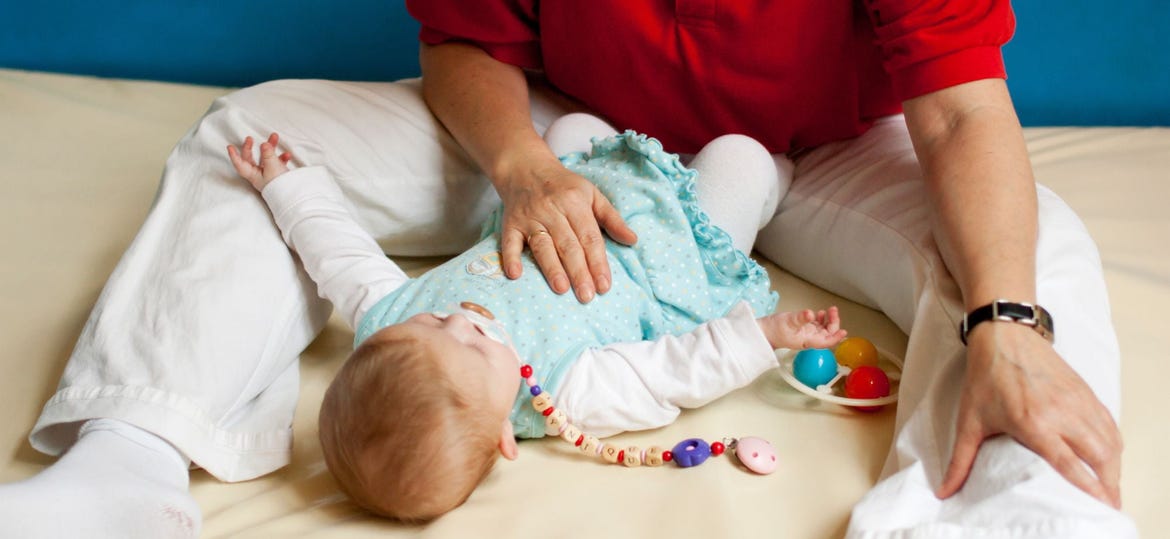
In BMC classes, parents learn to recognise these subtle moments. Rather than pulling a baby's hands to help them roll over, for example, they might apply gentle resistance to the sole of the baby's foot, allowing them to push off independently.
The art of mindful touch
Touch plays an important role in BMC. Through gentle, deliberate pressure applied over a broad area of the body (Somatic Touch), parents help their babies become aware of their physical boundaries. For example, if a baby is not yet fully aware of their right arm, gentle massage and pressure against the mat can help stimulate their nervous system. This encourages babies to explore and experience their bodies from within, right down to a cellular level. It is a fascinating combination of anatomy, mindfulness and close bonding.
🛍️ Helpful products for mindful moments
Discover gentle products to help you enjoy relaxing moments of mindful movement and touch with your baby:
Baby & child care: Natural, warming body oils for mindful Somatic Touch massages that help strengthen your baby's body awareness.
Equipment: Soft yet supportive mats and rugs that allow your baby to practise yielding and transferring their weight.
Frequently asked questions about Body-Mind Centring
Is BMC / Baby Moves the same as Pikler?
The two approaches have much in common, including a deep respect for each child's individual pace of development and an emphasis on allowing babies to reach sitting positions independently. However, BMC places greater emphasis on anatomy and internal body awareness. While the Pikler approach often focuses on observation, BMC encourages active involvement through mindful touch and gentle movement guidance.
Is BMC a therapy for children with developmental delays?
BMC is also used to support children with special needs or delays in motor development. However, Baby Moves classes are equally suitable for babies who are developing typically. Every child can benefit from exploring their body in such a detailed and mindful way.
Can I practise BMC at home?
Absolutely. You can start by following one of the most important principles of BMC: slow down. Watch carefully to see which part of their body your baby uses to initiate a movement (Is it their eyes or their foot?). Guide their movements with gentle, open hands rather than gripping or pulling, and always allow your baby to transfer their weight safely onto you.
Related products
-

David Fussenegger JUWEL Crocodile Play Mat, Lined
- Ideal for the children's room
- Cosy & easy to clean
- Cheerful design
-

farfalla Organic Almond Oil, 75 ml
- For dry skin types
- Safe for baby's and children's sensitive skin
- Moisturising
-

bieco Animal Puzzle Mat Blue 18 Pieces
- 18 pieces with numbers & animals
- Soft foam for crawling
- Can be shaped into a square or circle
-

FutuNatura 100% Almond Oil with Pump, 300 ml
- For face, hair and body
- Also ideal for massages
- With a practical dispenser
Magazine Articles:
-
Ireland: Free standard delivery from € 87,90
-
Free
returns Secure payments
with SSL encryption technology